Tuxedos for Men: Styles, Fit & Where to Wear One in Dubai
You step from the car into a Dubai hotel lobby, then spend the next hour between a humid terrace and strong ballroom air-conditioning. That is when a tuxedo earns its place. The jacket, shirt and trousers must still sit cleanly after the journey, not only in the fitting room.
I ask every client to begin with the invitation, venue and his build. A tuxedo is evening dress with silk or grosgrain lapel facings, a formal shirt and trousers finished to work with the jacket. The useful question is not simply “black or white”; it is whether every part belongs together for a black-tie ballroom, wedding reception or formal dinner in Dubai.
Who this guide is for
This is for a groom, guest, executive or first-time black-tie attendee who wants to buy a tuxedo suit with sound judgement rather than guesswork. You need not know a shawl lapel from a peak lapel before you arrive. You do need to know what the host expects, how long you will wear the garment, and whether the evening moves between a hotel ballroom, outdoor terrace, ceremony and formal dinner.
A tuxedo for men should look composed standing, sitting at dinner and getting out of a car. I treat those as three separate tests.
What you will learn
How invitation language directs the appropriate level of formality.
Which jacket style works for a black-tie dinner, wedding or formal reception.
Why lapel shape, trouser finish and shirt front must be chosen as one system.
How to check the shoulder, chest, waist and trouser line during a fitting.
Which cloth and lining decisions matter in Dubai’s heat and air-conditioning.
How to select tuxedo shoes without making the outfit look like office tailoring.
What a made-to-measure or bespoke consultation should settle before work begins.
Which visual details commonly spoil an otherwise sound black tuxedo.
Read the invitation before choosing the jacket

“Black tie” gives you a clear instruction: evening dress, not merely a dark business suit. For a gala, awards dinner, opera evening or formal hotel reception, I would usually put a man in a black tuxedo for men. Its restraint is the point.
“Black-tie optional” gives you more room, not a reason to avoid a tuxedo. A dark suit may be accepted. For a groom, host or principal guest, however, the tuxedo generally carries the occasion better.
Read wedding invitations more closely. A beach or daytime ceremony can support a lighter jacket when the couple has set that tone. A church ceremony followed by an evening reception may need greater formality. Ivory walls, a sea-facing terrace and a candlelit ballroom all change how cloth reads in photographs.
Not every formal jacket is a tuxedo. This comparison of tuxedo vs suit shows the dividing line at the lapel facing, trouser trim and shirt.
A simple occasion route
Start with the dress code. “Black tie” calls for a dinner suit or tuxedo. “Formal” needs interpretation from the venue and host.
Check the time. Evening events favour black or midnight tones. Daylight weddings can accommodate lighter formal jackets when the setting supports them.
Assess the setting. A ballroom tolerates a more structured jacket. An outdoor arrival needs lighter cloth and sensible lining choices.
Decide your role. The groom may choose a more individual jacket. A guest should not compete with the wedding party.
Build the full outfit. Confirm shirt, bow tie, trousers, socks and shoes before settling on the jacket.
Choose your tuxedo route
In fittings, I usually narrow the decision to three routes: a black single-breasted tuxedo, a double-breasted tuxedo, or a dinner jacket with black evening trousers. Each changes the silhouette before the bow tie goes on.
The black single-breasted tuxedo
This is the most useful black-tie choice. A one-button front keeps the waist clean when the jacket shapes the torso without pulling. It works for most formal evenings and asks no explanation of its wearer.
For the lapel, peak gives a firmer vertical line. Shawl is softer and continuous, with no notch. Neither is automatically better; I choose according to the shoulder line, chest and formality of the event.
The double-breasted tuxedo
More presence comes with a double-breasted jacket. It must close without strain and lie flat across the lower chest. Set the button stance too low and the torso shortens. Cut the front too tightly and it opens at the waist when you sit.
I recommend this route for a man comfortable keeping his jacket buttoned for most of the evening. It is less forgiving of a hurried fitting.
The dinner jacket
A dinner jacket is a separate evening jacket, usually worn with black tuxedo trousers. I use it for a celebratory wedding, a dinner with a clear style direction, or an occasion where black would look visually heavy. It does not make black tie informal; it introduces controlled contrast.
For finer distinctions in cloth, lapel finish and correct pairings, read Dinner Jacket vs Tuxedo Jacket.
Tail coat and ceremonial dress
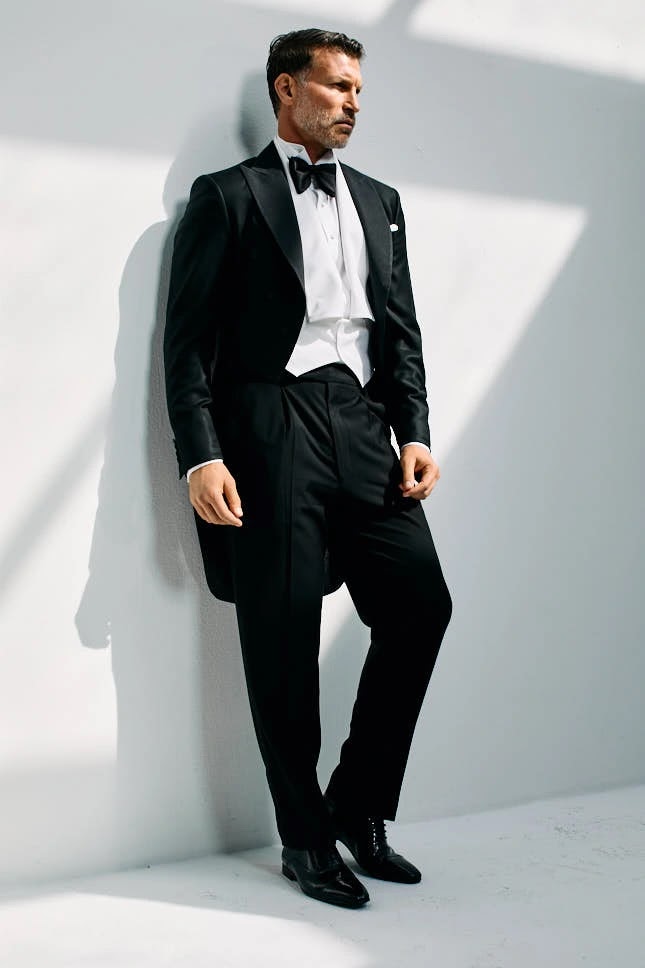
A tail coat is not a substitute for a black tuxedo. It belongs to white-tie dress, with a different shirt, waist covering and etiquette. I would select it only when the invitation or ceremonial setting genuinely calls for it.
The details that make a tuxedo
You see the distinction before the jacket is buttoned. A conventional tuxedo has lapels faced in silk or grosgrain, covered buttons, and trousers with a related stripe down the outer seam. The formal shirt, bow tie and evening trousers complete one system.
A dark suit with a bow tie remains a dark suit when its lapels use the same cloth, its buttons are ordinary horn and its trousers have no trim. It may be smart, but it lacks the deliberate contrast that reads under ballroom lighting.
The parts that should work together
Choose silk or grosgrain facings for the lapels, then use the same finish for the covered jacket buttons where appropriate.
Pair the jacket with formal trousers carrying a matching side stripe or braid rather than plain suit trousers.
Select a shirt with an evening front and cuffs that can take cufflinks.
Finish with a black bow tie and restrained black footwear.
Both peak and shawl lapels are correct. Peak frames the chest more sharply; shawl makes one curved line. In my experience, facing, button treatment and trouser finish matter more than choosing between those lapel shapes.
Black, midnight blue and lighter evening jackets

Black is the safest formal choice. I ask clients to consider midnight blue for evening events because artificial light can make it appear deeper than black while it still reads as restrained. In Dubai daylight, its blue cast is clearer, so inspect the cloth outside as well as beneath showroom lighting.
Lighter cloth needs a reason. Off-white, beige and shimmer finishes can suit destination weddings, warm-weather receptions and celebrations with a clear visual direction.
They are less suited to a strict black-tie gala, awards dinner or conservative corporate evening.
Keep the lower half disciplined. Pair a light dinner jacket with black evening trousers, a black bow tie and refined black shoes. Coloured trousers, patterned ties or contrasting footwear turn one controlled contrast into several competing ideas.
Fit checks that hold through an evening
I start at the shoulder. The seam should end where your shoulder ends, not drop down the upper arm or sit inside the shoulder point. A clean shoulder gives the lapel its line. No amount of waist suppression corrects a shoulder made for another body.
Then button the jacket and breathe normally. The chest should show a gently shaped front, not an X of tension from the button. Some waist suppression is correct. Pulling is not.
The jacket checks
The collar should meet the shirt collar without a visible gap at the back of the neck.
The lapels should lie close to the chest rather than bow outward.
The jacket length should balance your torso and seat, not merely follow a fashionable short cut.
The sleeve should allow a controlled amount of shirt cuff to show.
The vent should stay closed when you stand naturally. For the strictest evening dress, a ventless back is traditional, though a well-cut vented jacket can be more practical.
The trouser checks
Set tuxedo trousers at the natural waist, or close to it, rather than low on the hips. That keeps the shirt front tidy and the jacket-to-trouser proportion right. The leg should fall cleanly, with little or no break over the shoe according to your preference and trouser width.
A waistband that slides when you walk will show by the second hour. During a fitting, I ask a client to sit, cross one leg, stand again and take several steps.
Cloth, lining and Dubai conditions
Dubai asks more of evening cloth than a cool-weather city. You may stand outside for photographs, leave a warm car park for a cold ballroom, then remain beneath lighting for an hour. A tuxedo acceptable for five minutes can become tiring well before dessert.
For most local formal use, I inspect wool around 250 g before considering anything heavier. Weight alone is not the answer. Weave, finishing and lining change the result. Fine, breathable wools from mills such as Loro Piana carry a clean line through a warm evening, which is what evening tailoring needs in this climate.
An open, breathable weave can feel easier than a tightly finished cloth at the same stated weight. A heavy lining can undo a sensible cloth decision when you walk from the car to the lobby in humidity.
Consider the quiet architecture hidden within a jacket's chest: a layer of canvas suspended between the outer cloth and its lining, coaxing the garment into a form that feels almost alive on the body. When this construction is fully or partially canvassed, the resulting drape, how the fabric falls from the shoulders and moves in accord with the wearer, takes on a far more natural character than lesser methods allow. Yet craftsmanship in this hidden layer cannot compensate for an error elsewhere. Precision in cut remains paramount; no canvas, however finely made, will correct a misjudged shoulder line or restore balance where the foundation was flawed from the start.
For a broader explanation of fibre, weave and weight, see Suit Fabrics Explained. The same questions apply to evening tailoring, although lapel facing and formal finish add another decision.
Complete the outfit properly

The jacket gets attention first, but black tie is judged at the joins: collar to bow tie, shirt front to waistband, trouser hem to shoe. A correct tuxedo shirt has a structured evening front and must sit comfortably at the neck. Too loose, and the bow tie looks detached. Too tight, and every photograph shows it.
For collar choices, bib fronts and cuff details, see the tuxedo shirt.
Bow tie, pocket square and studs
A self-tied black bow tie is conventional. Keep it proportionate to your face and lapel, rather than spreading it across the whole collar. A white pocket square, flat-folded or in a restrained puff, is enough for most black-tie occasions.
For a clean presidential fold, lay the square flat, fold it in half, then fold the sides to the centre until it matches the pocket width. Set the visible edge at roughly 1 cm above the pocket. Do not pack the pocket; it should look placed.
Tuxedo shoes
Your shoes need enough formality to match the lapel facing. Black patent leather is traditional. Highly polished black calf leather also works when the shape is slim, plain and free from heavy broguing, thick soles or oversized hardware.
Evening shoes should recede beneath the trouser line. I would not choose brown shoes, trainer soles or bulky office loafers for black tie.
Waist coverings, braces and shirt finishing
When the jacket opens, the waist should remain uninterrupted. High-rise evening trousers often do this alone, particularly beneath a double-breasted jacket that stays fastened. If shirt front would show, choose a cummerbund or low-cut evening waistcoat.
A cummerbund gives a clean horizontal line with a single-breasted tuxedo. A low-cut waistcoat adds structure and must sit low enough to show shirt front and bow tie. Neither is needed when trouser rise, jacket fastening and shirt fit already keep the waist tidy.
Braces are the practical alternative to a belt. Formal evening trousers are usually made without belt loops because a buckle interrupts the shirt front and waist covering. Braces hold the trousers at the right height through dinner and dancing without excessive waistband tension.
Collar, cuffs and front fastening
A turndown collar is the most adaptable choice for modern black tie. A wing collar is more ceremonial and generally suits the most formal evening dress, particularly with a structured bow tie. Both require a close neck fit.
French cuffs and cufflinks are conventional. Shirt studs can replace visible buttons on a formal bib front, but keep them restrained. Black, mother-of-pearl or simple metal fittings leave attention on the jacket line.
Featured pieces to consider
Each of these pieces suggests a different formal route. I would judge the full outfit, not select a jacket in isolation.
Off White Tuxedo

This off-white wool tuxedo has a double-breasted front and peak lapel. Consider it where the setting, wedding palette and time of day make a lighter jacket appropriate. Off White Tuxedo
Beige Tuxedo Jacket

This single-breasted wool jacket has a beige shimmer finish and shawl lapel. It suits an occasion deliberately moved away from the standard black-tie palette while still requiring an evening-jacket silhouette. Beige Tuxedo Jacket
Black tail coat tuxedo

This tail coat takes a more ceremonial direction than a standard dinner suit. Confirm the dress code before choosing it, because it sets different expectations for the rest of the outfit. Black tail coat tuxedo
Black tuxedo Trousers

Black tuxedo trousers ground most dinner-jacket combinations. Give their waist position, hem and relationship to the shoe the same fitting attention as the jacket. Black tuxedo Trousers
Black tailcoat tuxedo

This is another tailcoat option for occasions specifically requiring that formal dress tradition. Treat it as a complete ceremonial outfit, not a variation on a conventional tuxedo suit. Black tailcoat tuxedo
Cherry Bespoke Shoe

This cherry loafer has fringes. Its colour and ornament make more sense for an individual formal look than strict black tie, where black evening footwear remains safer. Cherry Bespoke Shoe
Commissioning and collection
A proper consultation starts with the invitation, not the fabric book. Bring the event date, venue information and any direction from the wedding party or host. Bring shoes or a shirt you intend to wear as well; they affect trouser length, collar fit and the scale of the outfit.
At Vavci in Dubai, I would discuss the actual evening: arrival temperature, transport, time outdoors, photographs, dinner and dancing. A made-to-measure or bespoke tuxedo can then be shaped around posture, shoulder level, chest balance and preferred ease. A jacket may look right on its hanger and fail when you lift an arm or sit at a table.
Before finalising a black tuxedo suit, settle lapel facing, buttoning stance, trouser finish, shirt specification and shoes. Do not leave trousers to the final week. Their break and waist placement determine whether the jacket looks settled.
Common mistakes
Wearing a long tie with a tuxedo. A conventional black-tie outfit calls for a bow tie. A necktie changes the language of the outfit.
Using a business shirt. A standard spread-collar shirt can look disconnected from formal lapels and a bow tie.
Choosing trousers too low on the hips. This exposes shirt fabric and makes the jacket appear too short.
Overlooking the shoe. Thick rubber soles, heavy broguing and casual loafers draw the eye downward for the wrong reason.
Making the pocket square too theatrical. The square should support the lapel line, not become the main event.
Selecting a light jacket without reading the room. Off-white and beige can work well for the right wedding or celebration, but may look misplaced at a conservative evening gala.
Confusing military-inspired tailoring with black tie. Structured, decorative jackets have their own place. Military-Style Jackets for Men explains where that look works better.
Where to go from here
If the invitation says black tie and you are ready to commission, first narrow the route to black, double-breasted, dinner jacket or ceremonial tailcoat. Then settle the shirt and footwear before the fitting.
For a local ordering route and practical decision points, read Where to Order a Tuxedo Suit in Dubai Start to Finish. You can also browse the wider Tuxedos & Black Tie collection or compare formal accessories through Formal Shoes.
Frequently asked questions
What is a tuxedo?
Consider the silhouette that emerges once a bow tie is knotted beneath a satin-faced lapel, trousers finished with a matching braid, and the ensemble completed by a formal shirt and black evening shoes, this is the true signature of the tuxedo. Silk or grosgrain facings, echoed subtly in the button detailing, mark it as evening's most codified attire, reserved by tradition for occasions demanding absolute refinement.
Why is a tuxedo called a smoking jacket in some countries?
In parts of Europe, “smoking” describes what British and American dress traditions call a dinner jacket or tuxedo. The term means formal evening dress, not necessarily the separate velvet smoking jacket traditionally worn at home.
How is tuxedo pronounced?
Tuxedo is commonly pronounced “tuk-see-doh”. It is used most often in American English, while British tailoring language more often uses “dinner suit” or “dinner jacket”.
What is the difference between a tuxedo and a black suit?
Consider how a tuxedo lapel catches candlelight at a black-tie affair: the satin or grosgrain facing reflects with quiet precision, echoed in matching trim along the trouser seam. A black suit offers no such distinction, jacket and trousers share a single, uniform cloth throughout. It is this deliberate interplay of contrasting surfaces, composed for the theatre of evening light, that lends the tuxedo its unmistakably formal silhouette.
Can I wear a tuxedo to a wedding in Dubai?
Yes, when the timing, venue and couple’s dress direction support it. I would choose a black tuxedo for an evening wedding and formal reception. A lighter dinner jacket may suit a daylight or destination-style celebration where the couple has set a less conventional palette. Guests should not outdress the groom or ignore stated attire.
Should I choose a shawl lapel or a peak lapel?
Choose shawl for a smooth, continuous line that feels softer around the chest. Choose peak for more structure and vertical emphasis through the upper body. Shoulder width, jacket front and event also matter. Try both at the fitting rather than deciding from photographs alone.
Do tuxedo trousers need a belt?
No. Tuxedo trousers are cleaner without a belt, particularly when the waistband sits high and smooth beneath the jacket. The answer is a correctly fitted waistband. If you must continually adjust the trousers, reconsider the waist, rise or brace arrangement before the event.
What shoes should I wear with a black tuxedo?
Black patent leather evening shoes are traditional. Plain, highly polished black leather also works when it has a refined shape and minimal detailing. Avoid brown leather, trainers, thick soles and chunky brogues. The shoe should support the trouser line quietly.
Can I wear an off-white tuxedo jacket at night?
You can, but the occasion must support it. An off-white or beige jacket can work for a wedding, celebratory dinner or warm-weather event with a clear style direction. For a conservative charity dinner, awards evening or formal corporate gala, I would keep to black.
How should tuxedo trousers sit over the shoes?
Tuxedo trousers should fall cleanly with little break or no break, according to leg width and your preference. Too much cloth gathering above the shoe makes evening trousers look neglected. Assess the hem in the actual event shoes, not trainers or fitting-room slippers.
Should I commission a bespoke tuxedo for a single event?
Commissioning makes sense when the event matters, standard sizing is difficult to resolve, or you expect further formal evenings. It makes less sense when you need a garment immediately and are unlikely to wear it again. A proper consultation should establish that before any commitment.
Glossary
Canvas
A shaping layer inside a jacket that helps it mould and drape over the chest.
Drape
The way cloth hangs from the shoulders and moves over the body.
Grosgrain
A ribbed silk fabric often used for tuxedo lapel facings and trouser trim.
Peak lapel
A lapel with a pointed upper edge directed toward the shoulder.
Shawl lapel
A rounded lapel line with no notch, commonly seen on dinner jackets.
Break
The amount of trouser fabric resting on the shoe at the hem.
Key takeaways
The invitation and venue should determine the tuxedo route before colour or trend.
A black single-breasted tuxedo remains the most dependable option for formal evening occasions.
Shoulder fit, chest balance and trouser waist position matter more than decorative details.
Dubai conditions make cloth weight, weave and lining practical decisions, not minor specifications.
Shirt, bow tie and shoes must be selected as part of one evening outfit.
Conclusion
The right tuxedo suit for men need not announce itself. It should make a clean line from shoulder to shoe, suit the room’s formality and stay comfortable through the actual evening. For most black-tie invitations in Dubai, I would choose a well-fitted black tuxedo, correct shirt and restrained black shoe.
Choose a lighter jacket, shimmer finish or tailcoat only when the occasion gives you reason. That is not caution for its own sake. It is how evening dress remains convincing in photographs, at dinner and after midnight.
Please note that the counsel offered here remains a point of departure rather than a fixed rule, best interpreted alongside the particulars of the host's dress code, the character of the venue and any prevailing cultural sensibilities. Matters of availability, precise garment specification, fabric selection, fit and the arrangements surrounding bespoke commissioning and delivery are best confirmed directly with Vavci, ideally before any purchase is made or appointment secured.