

Business Casual Rules for Men, Explained Piece by Piece
I see the same problem before client lunches and interviews: one good piece, then one garment that belongs to the weekend. Business casual for men asks for a collared shirt, tailored trousers, proper shoes and, when the room warrants it, a separate jacket rather than a matching suit. The test is not whether the outfit feels “smart”. Each piece must carry its share of formality. A relaxed shirt, trousers tight through the thigh, or shoes made for denim can unsettle the whole look. In Dubai, the cloth matters as much as the appearance. You may cross the pavement for five minutes, then spend three hours in severe air-conditioning. Use this checklist for an office meeting, client lunch, interview, or dinner where a full suit would be too much. For the wider code, read our Business Casual for Men guide.
The Full Checklist
Copy this before you dress. Business casual usually fails because one garment was chosen on its own.
-
Choose a jacket only if the meeting, venue, or client-facing role needs a sharper outline.
-
Check that your shirt has a collar that sits cleanly without a tie.
-
Choose trousers with a neat waistband, a clean line through the seat, and little or no break.
-
Match the formality of the jacket, shirt, and trousers rather than making one piece do all the work.
-
Wear leather shoes with a defined shape, not trainers or heavy leisure footwear.
-
Confirm that the fabric will remain comfortable between the car, pavement, lobby, and office.
-
Move, sit, and raise your arms before leaving. A standing mirror can conceal a poor working fit.
Office Dress-Code Decoder
Read the room first. A conservative finance office may expect a long-sleeved shirt, wool trousers, leather shoes, and a jacket ready for client meetings. In professional services, the same base usually works, but the jacket matters more when you present work, meet clients, or attend a formal lunch.
Creative workplaces permit more texture and personality. An open-collar Oxford shirt, knitted polo, loafers, or an expressive jacket may work there. A relaxed technology office may accept dark denim and clean trainers, but that does not make either a sound choice for an interview or a first meeting with a senior client.
When you do not know the room, dress one degree smarter.
For a first meeting, interview, presentation, or unfamiliar office, begin with tailored trousers, a long-sleeved collared shirt, leather shoes, and a jacket if the role is client-facing. You can take the jacket off later. Recovering from arriving underdressed is harder.
As formality rises, the choices narrow. Jackets become safer, chinos need a cleaner finish, and denim becomes less useful. Loafers work in many offices; trainers usually belong only in clearly relaxed ones. In a conservative room, visible logos, distressed denim, casual collars, and sporty soles add nothing.
Jacket Choices

A jacket is optional in many business casual offices. I reach for one when meeting a new client, interviewing for a senior role, presenting, or going from work to dinner. Leave it out when the room is plainly relaxed. A jacket worn among open-collar shirts can make you appear less certain, not better dressed.
In Dubai, I would usually start with an unstructured or lightly constructed blazer. That means less internal padding and less canvas through the chest. It follows the body instead of holding a rigid military shape. A full canvas jacket has a floating horsehair layer between cloth and lining. It can drape beautifully, but it is not automatically right for a humid weekday.
Start with the occasion, not the jacket.

Beige Blazer is a wool jacket with a notch lapel that works as a separate blazer rather than part of a suit. Its neutral colour is easy to place, so it suits daytime meetings and client lunches with a pale shirt and darker brown or navy trousers for contrast.

Green Blazer is cut in a linen and silk blend with a single-breasted front and notch lapel. Green reads as personality rather than corporate uniform, so it fits a creative office or a relaxed client lunch more than a conservative first interview. Pair it with a white or pale blue shirt and neutral trousers.

Wine Double Breasted Blazer is the bolder choice, cut double-breasted in a linen and silk blend with a peak lapel. The colour and double-breasted front make it an evening or occasion jacket rather than a daily one, so keep the shirt and trousers plain and let the blazer lead.

Orange Shacket sits between a shirt and a jacket in cotton, so it belongs only in a genuinely relaxed office or a casual evening. It is the most informal option here; keep the trousers quiet and the shoes simple, and leave it out of any interview or formal client meeting.
Shirt Choices
The shirt carries most business casual outfits. Begin with white, pale blue, soft grey, or a restrained stripe. Oxford cloth has visible texture and works well without a jacket. Poplin is smoother and slightly dressier. A spread or semi-spread collar generally sits best when worn open.
Check the collar before anything else. It should sit against the neck without a gap at the back, while the shoulder seam ends at your shoulder point. A collapsed collar or oversized shoulder makes even good trousers and shoes look accidental.
Do not rely on a loud printed shirt for interest. Texture is quieter and generally more convincing: a fine Oxford weave, subtle stripe, or knitted polo in a genuinely relaxed office. For an interview, I would normally choose a long-sleeved collared shirt over a polo.
Knitwear and Polo Shirts
A fine-gauge merino knit can replace a shirt in a relaxed office, especially over light cotton in strong air-conditioning. A knitted polo can also work with tailored trousers and leather shoes where the office is genuinely informal. Keep the knit close to the body, without gripping the chest or waist.
Weight decides a great deal in Dubai.
Fine merino and breathable cotton can work indoors, but heavier knitwear becomes difficult once you step into heat and humidity. If your day involves moving between buildings, a light overshirt may be easier than a thick knit, provided the office does not require a jacket.
Heavy jersey, large logos, rugby-style collars, and short-sleeved polos send a more casual message. I would not wear them for an interview, formal client meeting, or presentation where authority needs to be established before you speak. A long-sleeved shirt gives a cleaner collar line and more dependable structure under a jacket.
Trouser Choices
Trousers decide whether an outfit reads as business casual or weekend dressing. Choose a wool trouser, a clean-finished cotton chino, or a linen trouser with a measured fit. The waistband should remain in place without being pulled up during the day. Pleats are acceptable when they lie flat. Side adjusters can give a cleaner waist than a belt, particularly beneath a jacket.
Look at the hem from the side. It should touch the shoe lightly or sit just above it: little or no break. A deep stack around the ankle looks untidy, especially on a slim trouser. Too-short trousers are no better. In a client meeting, see the shoe, not several centimetres of bare ankle.
Linen has a different purpose. It will crease at the knee and hip, so choose it for texture and ease, not for the flat formality of wool.
Shoe Choices
Shoes set the lower boundary of the code. Black cap-toe Oxfords are often too formal for business casual, though they remain appropriate for a formal interview. Brown derbies, loafers, and restrained monk straps offer more range. Keep the leather clean and the sole slim enough to sit beneath a trouser without looking heavy.
For a fuller breakdown of loafers, derbies, monk straps, and where each works best, see The Shoes That Actually Work With Business Casual.
Business Casual Outfit Combinations
Start with one dependable base: a pale blue shirt, navy trousers, and brown derbies. It works in most professional offices because every piece is quiet and the contrast is clear. Add a navy or textured grey jacket for a client meeting. Remove it for a more relaxed day.
For a daytime client lunch, pair a pale blue or white shirt with darker navy or brown trousers and a beige linen jacket. The jacket should read as deliberately separate from the trousers. A close but imperfect colour match can look like a suit that lost its trousers.
For a sharper result, choose grey trousers, a white shirt, and black footwear.
That combination works for a presentation or an evening dinner after work. Navy works with brown or black shoes. Beige and olive trousers usually sit better with brown footwear. Black shoes are strongest with charcoal, navy, and darker grey, not pale linen trousers.
A relaxed office can take a knitted polo with navy trousers and loafers. For dinner, replace the polo with a shirt or add a jacket instead of adding another casual layer. The trousers and shoes remain consistent, so the result still reads as a considered set.
Fit and Finishing Checks
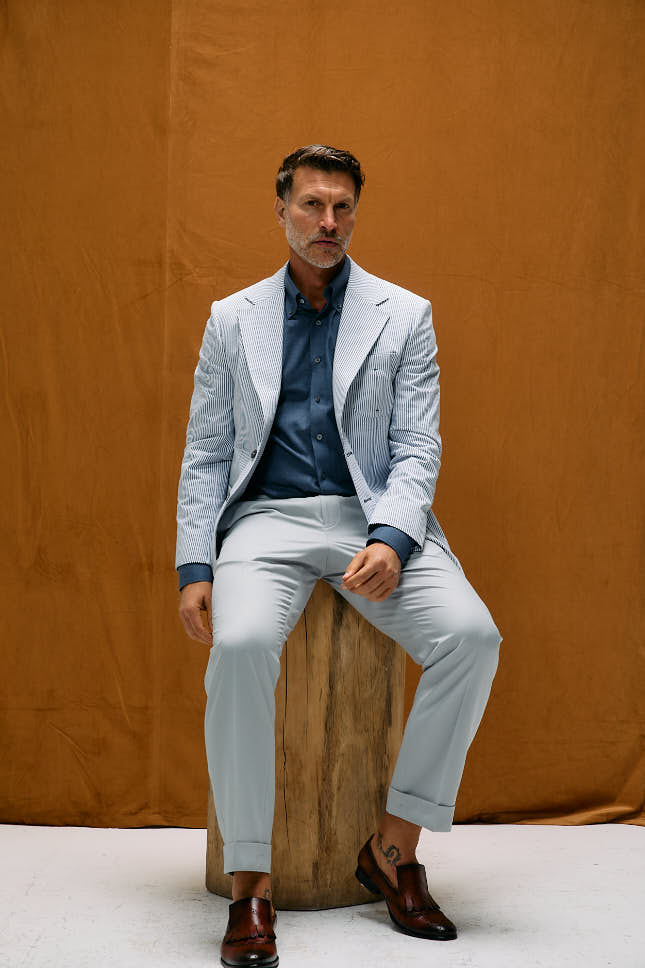
Do the final check sitting down. A jacket can look clean standing, then pull at the button when you drive. Trousers can grip the thigh. A shirt can open at the chest. Those are fit problems, not styling problems.
-
Confirm that the jacket shoulder ends where your shoulder ends, with no ridge or dip.
-
Check that one finger can sit between your shirt collar and neck without strain.
-
Confirm that trouser pockets lie flat rather than opening at the hip.
-
Check that socks cover the calf when seated.
-
Remove the visible sports watch if the event is more formal than the office.
Made properly, a jacket can be worthwhile when ready-made shoulders repeatedly fail you, one shoulder sits lower, or you need a particular cloth and construction. Bespoke tailoring is not necessary for every business casual day. If you need clothes quickly, well-fitting ready-made shirts and trousers, altered properly, can be the better answer.
Pros and Cons
Strengths
-
Business casual gives more comfort than a matching suit while retaining professional credibility.
-
Separate jackets and trousers create several outfits from a smaller number of garments.
-
Open-collar shirts suit Dubai’s heat better than a tie for many meetings.
-
Wool, cotton, and linen offer distinct choices for office air-conditioning, outdoor movement, and evening plans.
-
A piece-by-piece approach makes it easier to correct one weak garment before it affects the entire outfit.
Considerations
-
The code changes between companies, so a relaxed creative office may dress very differently from a financial firm.
-
Linen is cooler-looking and visibly textured, but it creases more readily than wool.
-
Slim trousers can look sharp but may restrict movement if the thigh and seat are cut too close.
-
Monk straps and loafers may be too expressive for the most conservative interview environments.
Frequently Asked Questions
What is business casual for men?
Think of business casual for men as professional clothing without the requirement for a matching suit and tie. It usually means a collared shirt, tailored trousers, leather shoes, and an optional blazer. It does not mean clothing for the gym, beach, or weekend errands. Your employer and the purpose of the meeting set the precise standard.
Can I wear jeans for business casual?
Dark, plain jeans can work in some relaxed offices, but trousers are safer for a client meeting, interview, or presentation. Denim retains casual associations even when it is dark. If uncertain, start with wool trousers or clean chinos. You can relax the outfit once you understand the office standard.
Do I need a blazer for business casual attire for men?
No. A blazer is not required every day. Wear one when authority, first impressions, or an evening transition matters. A shirt and well-cut trousers can be fully appropriate in a warm Dubai office. The blazer must fit at the shoulder and let you sit comfortably, or it becomes an inconvenience.
What is the best business casual outfit for an interview?
For most interviews, I would choose a pale blue or white collared shirt, navy or charcoal trousers, polished leather shoes, and a restrained blazer for a client-facing or senior role. Avoid visible logos, loud patterns, distressed fabrics, and overly narrow cuts. Research the company, then dress one degree more formally than you expect the daily office standard to be.
What are the best business casual work shoes?
Brown derbies, penny loafers, tassel loafers, and clean monk straps are sound business casual work shoes. Choose black footwear with navy, charcoal, or darker trousers, and brown footwear with navy, beige, olive, or mid-grey. Keep the shoe polished, well-shaped, and free of thick athletic-style soles.
What is the difference between smart casual and business casual for men?
Business casual has a professional purpose at its centre, so tailored trousers, collared shirts, and leather shoes remain the starting point. Smart casual permits more personal expression and may include refined knitwear, darker denim, or cleaner trainers depending on the venue. For work, interviews, and client-facing settings, business casual is the safer choice.
What is the 3-3-3 rule for clothes?
The 3-3-3 rule usually means three tops, three bottoms, and three pairs of shoes that combine into several outfits. It helps build a smaller working wardrobe without repeating the same look daily. For business casual, make the core pieces shirts or fine knits, tailored trousers, and leather shoes rather than purely casual clothing.
Do I need to wear a suit for business casual?
No, business casual does not require a matching suit. Separate trousers, a collared shirt, proper leather shoes, and an optional blazer are normally enough. A suit may still be wiser for a formal interview, a conservative financial firm, or an occasion where the invitation specifically asks for one.
What if You Cannot Tick Every Box?
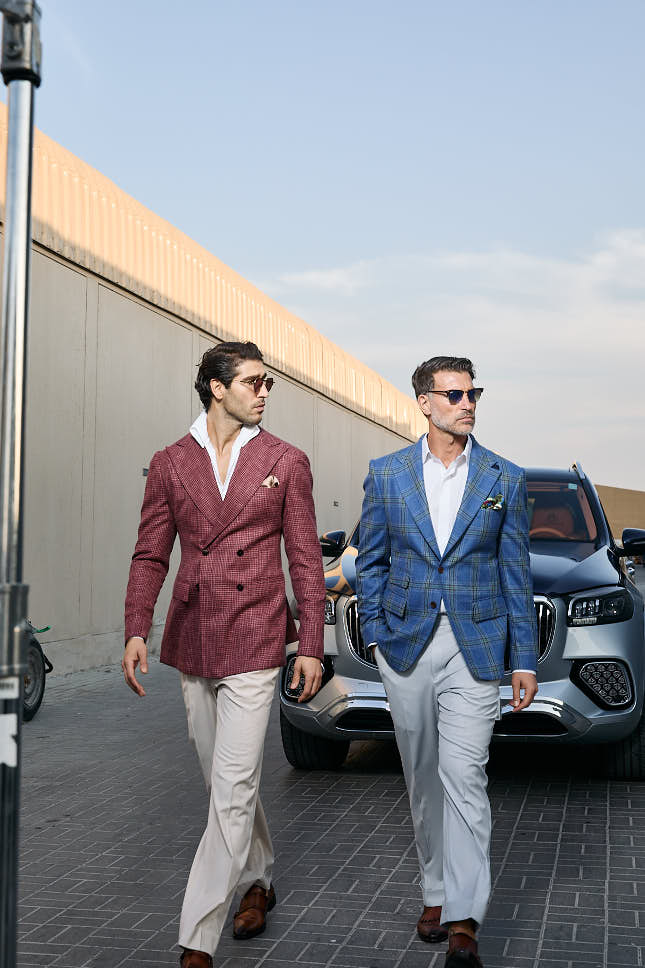
Prioritise fit, cleanliness, and proportion. A plain shirt that fits at the neck and shoulder is better than an expensive patterned shirt with a collapsed collar. Correct trouser length matters more than a pocket square. Clean leather shoes matter more than a fashion-forward buckle.
Own one reliable combination first: a blue shirt, dark trousers, brown leather shoes, and a simple jacket where needed. Build from there. Replace the garment causing the most trouble rather than buying several pieces that repeat the same weakness.
Key Takeaways
-
Judge business casual as a set of jacket, shirt, trousers, and shoes, not as a vague dress code.
-
Use a jacket for meetings that need authority, not automatically for every working day.
-
Choose trousers with a clean seat, adequate thigh room, and a controlled break.
-
Keep footwear leather, polished, and proportionate to the trouser.
-
For Dubai, choose cloth and construction that can handle heat outside and cold air-conditioning indoors.
Conclusion
The best business casual outfit is usually quieter than expected. A good collar, trousers that hang straight, and cared-for shoes carry more weight than unusual colours or accessories. Start with the garment that works hardest in your week. For some men, that is a breathable blazer for client meetings. For others, it is trousers that remain comfortable after a long drive and a full day at a desk. If ready-made clothing leaves you fighting the shoulders, sleeve length, or trouser balance, a private fitting can show what needs correcting rather than covering up.
Style guidance is general and should be adjusted for your employer, event invitation, and personal comfort. Product availability, fabric composition, sizing, and garment details may change. Bespoke, custom-made, and made-to-measure garments require an individual consultation and fitting process.