

Sherwani for Men: Styles, Fabric & Occasion Guide for Dubai
Who this guide is for: The way a groom chooses a sherwani for men has changed. Where the instinct was once to reach for the heaviest, most decorated coat in the room, today's groom weighs heritage against how he actually wants to look, family expectation against his own restraint, and a single ceremonial entrance against a wedding that now runs across several events and settings. A sherwani is still a long, structured ceremonial coat, buttoned to the neck and worn with fitted lower garments, chosen for weddings, receptions, festivals and formal family occasions. What has changed is how carefully men now choose one.
What has not changed is what it stands for. To wear a sherwani on your wedding day is to step into a long line of men who dressed with intention for the person they were committing to. The structured collar, the closed front, the length that makes a man stand differently, all of it still reads as a quiet statement: this day matters, and so does the promise being made. The modern groom simply arrives at that statement on his own terms, through fit and proportion rather than sheer weight of decoration.
So before choosing colour, handwork or a label, I start with what the day will ask of the garment. In Dubai that matters: a midnight reception in strong air-conditioning is not the same as a daytime baraat or a long outdoor entrance. From there I will take you through the principal silhouettes, fabrics, ornament, footwear and fitting points that keep a sherwani composed rather than merely elaborate.
What you will learn
How to tell straight-cut, layered and more decorative sherwani routes apart.
Which occasions need restraint and which can carry stronger handwork.
How velvet, georgette, raw silk and silk alter a garment’s visual weight.
Why shoulder balance, neck comfort and walking length matter more than chest size alone.
How to select lower garments without interrupting the coat’s vertical line.
What to consider before adding a dupatta.
How shoe shape changes the result from the hem upward.
Where made-to-measure work is more useful than a simple alteration.
The main style routes
The classic straight-cut sherwani
For most grooms, I begin with the straight-cut sherwani. Its front falls cleanly from shoulder to hem, with limited flare and controlled room through the hip. It gives you formality without a theatrical outline.
That clean front gives buttons and surface work space to register. Hand embellishment needs a quiet line beneath it. Too much flare, contrasting trim and a shaped hem create competing details instead of one resolved garment.
The royal or ceremonial route
A more ceremonial sherwani uses a firmer collar, richer cloth, denser work or a dupatta. It suits a main wedding entrance, a formal stage and evening photographs. “Royal” is used loosely; in practical terms, it means enough structure and visual depth to hold a large room.
Weight is the trade-off. Thick cloth, a fully lined body and decoration across the chest can become tiring in Dubai before the evening has settled. Keep the internal construction disciplined. A coat can look substantial without unnecessary layers.
The lighter modern route
Some men want sherwani formality without visual density. Lighter cloth, a plain body and precisely placed handwork do that well. I often suggest this route for daytime ceremonies, smaller family functions and men accustomed to Western tailoring rather than heavily decorated coats.
Minimal still has to look deliberate. With less surface work, the collar, buttons, sleeve finish and lower-garment break become more visible.
Indo-Western alternatives
Where the event permits a shorter jacket, asymmetric closure or a more relaxed lower garment, an Indo-Western outfit for men may be the better route. It does not replace a traditional wedding sherwani at every ceremony. It does work well for a reception, sangeet or guest dressing, where movement and a sharper contemporary line matter more than convention.
Matching the garment to the occasion

For the groom
A marriage sherwani for a man must survive more than the entrance photograph. You will sit for rituals, stand beneath lights, greet guests and move between indoor and outdoor settings as the evening unfolds. I ask for the schedule first. A coat chosen only for the stage can feel wrong by its second hour.
For a formal evening wedding, deeper tones, silk or velvet-like depth and controlled embellishment work well. In daylight, white, ivory, pale gold and softer colours are easier on the eye, but they reveal poor fit quickly. The collar must sit flat, the front edge stay vertical and the hem must not pull back as you walk.
For family and guests
Guests should not dress as a second groom. A refined male sherwani can take decorative buttons, textured cloth or a contrasting pocket detail, but its visual weight should remain below the central wedding party. This matters especially when the groom wears a dupatta, dense handwork or a very pale ceremonial coat.
A Jodhpuri suit is often the more reserved choice for an evening function. Read our guide to royal-style Jodhpuri suits for wedding grooms if you are weighing the two silhouettes.
For festivals and formal dinners
Festival dressing permits more colour and texture, but comfort decides whether you wear the garment again. A lighter sherwani dress for men, with limited internal padding and a clean lower garment, is usually wiser for a home dinner or an event where you will sit through most of the evening.
Keep the most structured, embellished pieces for occasions with enough scale to justify them. Not every formal invitation needs a statement coat.
Colour and ceremony
Colour shifts between daylight, a ballroom and wedding photography. Ivory and white read cleanly in natural light, though they can appear brighter against a dark stage. Gold gains warmth under evening lighting. Black becomes a concentrated silhouette unless texture or surface work catches the light.
Pink, deep green and wine carry more presence. They can work when the wedding palette supports them, but assess them beside the bride and groom’s colours, the stage backdrop and immediate family dress before confirming the garment.
Never judge a strong colour in isolation. A wine sherwani can look restrained in a dim ballroom and much stronger in direct afternoon sun. Deep green may photograph almost black, while pale gold can take on the colour of nearby décor.
Guests have more room for colour and texture, but the strongest ceremonial contrast belongs to the groom. A darker tone, textured silk or controlled detail is usually sufficient. Dense metallic work, a prominent dupatta and a very pale formal coat may compete in photographs.
Fabric, lining and Dubai conditions
Velvet
Velvet has immediate depth because its pile catches light differently as you move. It belongs at evening ceremonies and formal indoor settings. In photographs, a velvet sherwani can appear almost black from one angle and reveal its true tone from another.
There is a limit. Velvet retains warmth, and its density can make a broad chest or short neck appear heavier. I would not recommend it for a long outdoor daytime programme unless you will spend most of it indoors.
Raw silk and silk
Raw silk has a dry, textured surface rather than a smooth shine. Choose it when colour should look rich but not glossy. Silk can also carry detailed doori work clearly, giving contrast without excessive bulk.
Both demand care. A pulled thread, drink spill or repeated friction from a shoulder strap can mark the surface. Treat the event garment accordingly; it is not an everyday jacket.
Georgette
Georgette looks lighter and can soften a formal white sherwani. It is a sensible option for men who dislike the stiffness associated with ceremonial dress. A lighter appearance does not remove the need for a shaped collar and stable front edge.
Lining and airflow
In Dubai, lining is a construction decision, not decoration. Full lining helps a coat slide over a kurta and gives the interior a smoother finish, but it also changes how warm it feels. For a summer event, consider the outdoor standing time and whether the venue is heavily air-conditioned.
The answer is rarely as little lining as possible. An unsupported coat can collapse around its buttons. Use enough structure to hold the front cleanly, without making the sherwani a sealed shell.
Embroidery and surface work
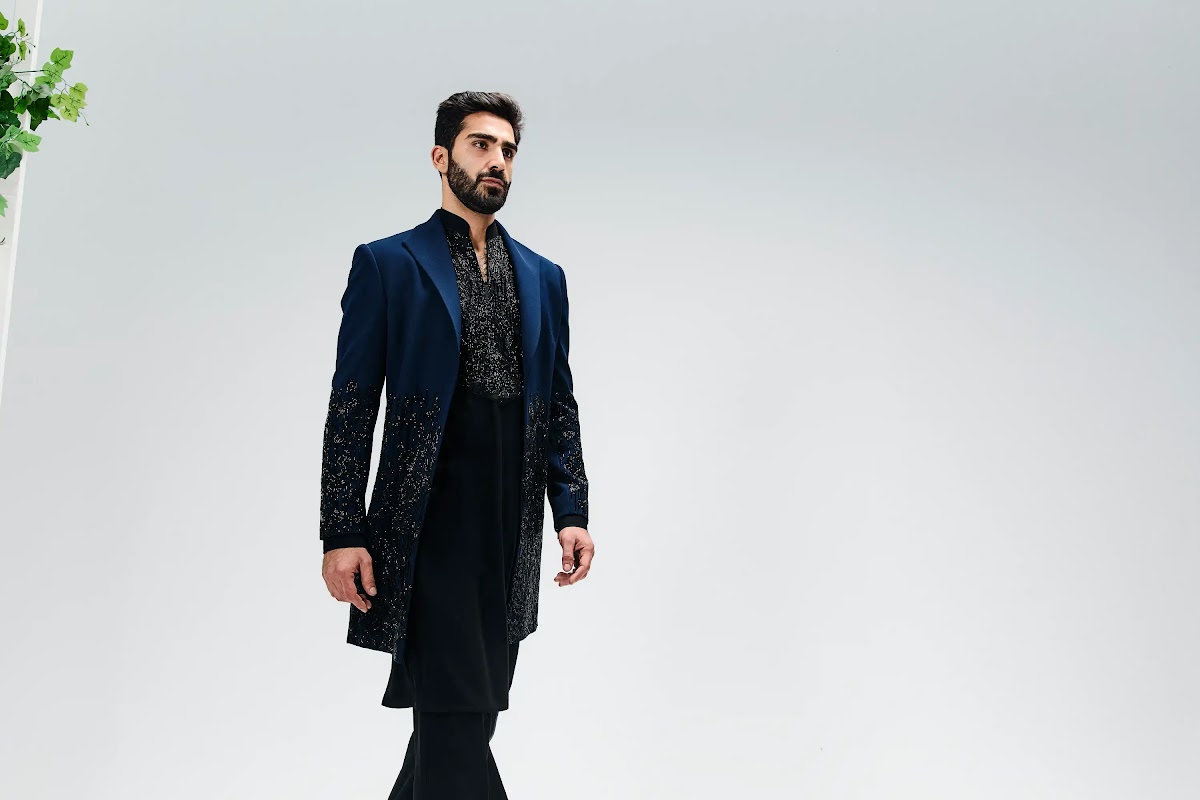
Surface work changes both formality and apparent proportion. Restrained hand embellishment around the collar, button stand or cuffs gives the eye somewhere to settle while leaving the main body clear.
Doori work behaves differently. Its cord-like lines can outline the front, frame the chest or make a deliberate pattern across silk. Embroidery may cover a small area or extend across the garment; denser ceremonial decoration produces a richer surface under evening light.
Placement matters as much as quantity. Broad chest work can make the upper body look wider. A vertical button stand and a controlled hem border preserve length. Collar and cuff work draw the eye upward, useful only when shoulder line and neck balance are already right.
A groom can choose stronger decoration when the ceremony and stage demand it. Immediate family may wear detailed work, but should usually step back from the groom’s visual weight. For guests, a quiet collar, buttons or a small textured area is often enough.
How a sherwani should fit
Start at the neck
Start with the collar. It should meet the neck without a visible gap or throat pressure when you turn your head. Fasten the top button, look down, then sit. If it climbs into the jaw or opens away from the neck, the pattern needs work.
Check the shoulder line
The shoulder seam should end where your own shoulder ends. Overhanging shoulders make the sleeve look borrowed. A narrow shoulder causes horizontal pulls from the upper back towards the button stand.
Judge the front while moving
A useful fitting-room test has three parts:
Button the garment and stand naturally, without pulling your shoulders back for the mirror.
Walk ten steps and see whether the front edges remain parallel.
Sit on a firm chair for several minutes, then stand and check whether the coat twists or rides behind you.
The hem should move with you, not catch at the knee. A high side slit can improve stride, but it must be cleanly placed and finished. Too little hip room pulls the front open. Too much produces a tent-like outline.
Get the sleeves right
Sleeves must let you greet guests, hold a phone and sit without lifting the whole body of the sherwani. The cuff should finish cleanly at the wrist. Excess length gathers at the hand and immediately makes formal clothing look less precise.
For a closer examination, see how a sherwani should actually fit from shoulder to hem.
A practical selection sequence
1. Establish your role
First establish whether you are the groom, immediate family or a guest. That sets the formality and appropriate decoration. It also stops a familiar mistake: selecting the most elaborate piece before considering the bride and groom’s setting.
2. Confirm the time and venue
Daylight exposes texture, creasing and colour variation. Evening lighting gives metallic work and velvet more depth. Outdoor moments bring heat and humidity into the decision. After sunset, indoor ballrooms can be cool enough for denser cloth.
3. Choose the silhouette before the surface
Choose straight-cut, more ceremonial or Indo-Western lines before handwork. A shorter torso usually benefits from a clear vertical front and restrained contrast. A taller wearer can take more length, though excess volume still adds width.
4. Build the colour around the event
White and ivory are formal, photograph well and suit daytime functions. Black, wine, deep green and midnight tones generally suit evening. Gold requires restraint. Buttons or fine doori work can carry it; broad metallic surfaces are not necessary for formality.
5. Finalise the lower half and footwear
Bring the intended shoes to the final fitting where possible. Hem length and lower-garment break change once the shoe is on. Many otherwise good sherwani looks lose their balance at this stage.
What goes into a sherwani

What goes into a sherwani shows in the work within it, not merely its colour or decoration seen from a distance. Cloth is one part. Velvet, raw silk, silk and georgette need different handling; lining, buttons and internal construction determine how the coat sits through the event.
Hand-applied surface work takes time because every element is placed by hand. Repeated machine work creates a regular pattern more quickly. Neither is automatically better. Look at the design scale, its placement on the body and whether it supports the coat’s shape.
Doori work, detailed hand embellishment, a lined interior and involved button treatment all add labour. More work may also be needed when the pattern requires individual adjustment rather than a standard size altered at sides and sleeves.
Made-to-measure is most useful when shoulders are uneven, the collar will not sit, the required length differs materially from standard proportion, or the hip needs room without excess chest width. A minor alteration can shorten sleeves or refine a waist. It cannot reliably rebuild shoulder balance or reposition a collar that was wrong from the beginning.
Five formalwear references
These pieces show how cloth, colour and decoration shift a sherwani towards different occasions. The right choice still depends on your proportion, event timing and the ceremonial presence the setting needs.
Black Velvet With Hand Embroidery & Dupatta
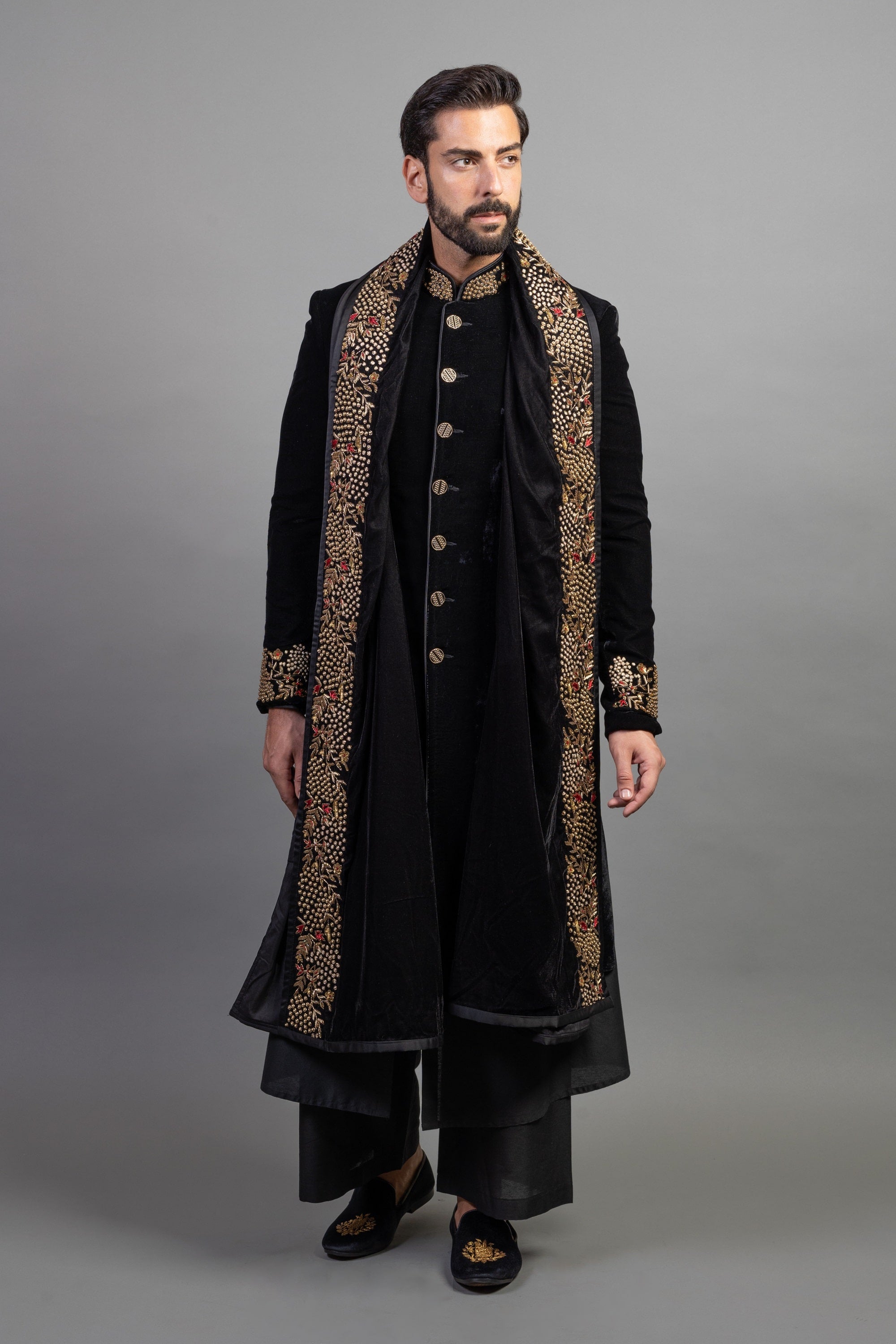
This velvet sherwani has a classic straight cut, hand embellishment and a dupatta. It suits a formal wedding where a groom wants visual depth while keeping a disciplined vertical shape.
White Sherwani With Embroidery
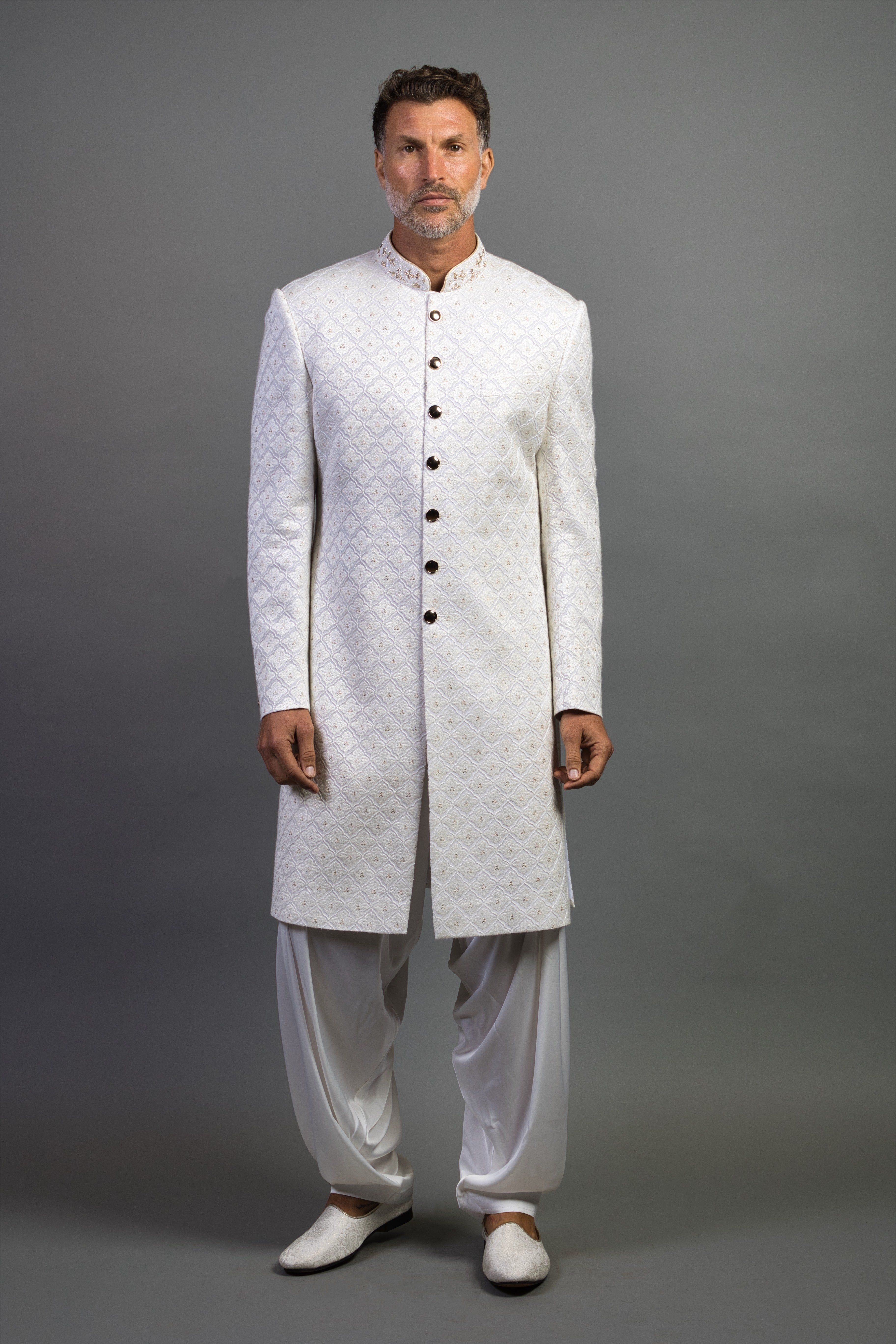
This white georgette option has hand embellishment, a classic cut and a straight-cut bottom. Its lighter visual character makes it a useful reference for daytime ceremonies and men who prefer less dense surface treatment.
Pink Embroidered Sherwani With Dupatta & Anarkali
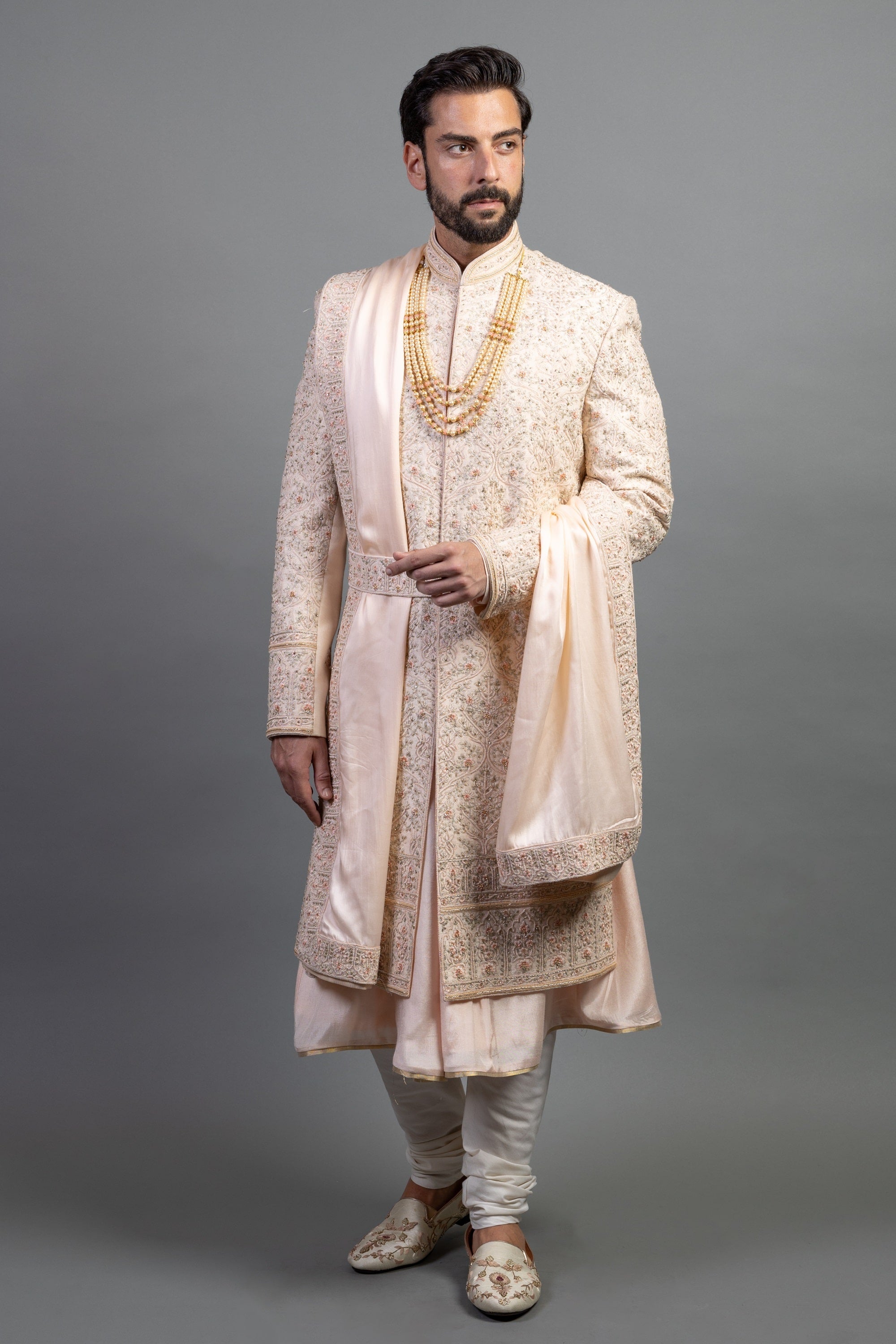
This pink raw silk sherwani uses a classic cut with a straight-cut bottom, a coordinated dupatta and anarkali. It shows a more expressive wedding route, where colour forms part of the ceremonial statement rather than a small accent.
Black Vevet Sherwani

This black velvet sherwani has hand embellishment and a classic straight-cut profile. It is a useful evening reference where venue lighting and formality support a darker, more concentrated look.
Gold Doori Work Sherwani

This gold silk sherwani is cut in a classic straight shape and finished with intricate doori work. It shows how strong colour and detailed surface remain orderly when the underlying silhouette stays simple.
Lower garments, dupattas and shoes
Keeping the lower line clean
Churidar, straight trousers and coordinated ceremonial bottoms each finish the coat differently. Proportion is the essential point. A narrow, controlled lower line lengthens the body beneath a straight sherwani. Excess cloth at the ankle distracts from the coat and makes walking harder.
Wearing a dupatta properly
A dupatta needs a purpose. It can frame a groom’s shoulder line, introduce colour or complete a traditional ceremonial look. Do not add one simply because the coat appears insufficient alone.
At the fitting, practise standing, sitting and greeting someone in it. If it slips, catches at buttons or covers the most considered part of the coat, alter the drape instead of accepting the inconvenience.
Footwear
Formal shoes need a narrow enough profile to sit neatly beneath the hem. Loafers, traditional formal footwear or a polished closed shoe may work, depending on the lower garment and ceremony. Avoid a thick athletic sole. It stops the vertical line abruptly at the floor.
For a Western office wardrobe, the rules differ. Our guide to office shoes for men covers shapes that work with trousers and tailored suits.
Strengths and considerations

Strengths
A sherwani creates a clearly formal silhouette for weddings and ceremonial occasions.
Straight-cut versions can make the body appear longer and more composed.
Fabric, buttons, collar and handwork allow considerable personal expression.
A well-planned outfit can serve the ceremony, reception and formal photography.
Made-to-measure work can address shoulder slope, hip balance, sleeve length and collar comfort.
Considerations
Dense fabrics and full lining may become uncomfortable during outdoor periods in Dubai.
Heavy decoration can overwhelm a smaller frame or compete with the groom’s role.
Alterations cannot always correct a misplaced collar, incorrect shoulder width or wrong length.
A dupatta and long hem need rehearsal before the event, especially if you will sit often.
Common mistakes
Choosing from a single front-facing photograph
Judge a sherwani from side and back as well as front. Check where the hem lands, whether the side slit opens cleanly and how the collar behaves in motion. A good still image cannot show these things.
Adding decoration to solve a weak silhouette
Handwork cannot correct a broad shoulder or a front pulling across the hip. Establish shape first. Detail should support the garment, not distract from its faults.
Ignoring the event schedule
Many men choose as though they will stand in one cool room for twenty minutes. Weddings do not work that way. The entrance, the rituals, the greetings and the time spent under warm lights can move you through very different conditions across an evening.
Leaving footwear until the end
The wrong shoe changes trouser break and apparent sherwani length. It can make walking awkward too. Bring the intended pair to the fitting.
Further reading
Once the broad direction is clear, narrow it by occasion and visual weight. Our edit of 10 sherwani designs genuinely worth considering compares distinct routes without pretending every decorative feature is essential.
For a Dubai-specific decision, read where to buy the best sherwani in Dubai right now. You can also browse the wider Indian & Ethnic Wear collection for related formalwear guidance.
Frequently asked questions
What is the difference between a sherwani and a kurta?
A sherwani is generally longer, more structured and more formal than a kurta. It commonly has a shaped collar, buttoned front and ceremonial finish. A kurta is usually lighter and less constructed, making it easier for informal gatherings and regular wear. Let event formality decide, not colour or decoration alone.
Can I wear a sherwani as a wedding guest?
Yes, if the decoration respects the occasion and does not compete with the groom. Choose a controlled silhouette, avoid bridal-level surface work and keep colour appropriate to the timing. A guest sherwani should look considered without becoming the focus of family photographs or the stage.
Which fabric is most suitable for a Dubai wedding?
The answer depends on time, venue and outdoor exposure. Georgette gives a lighter visual route, while raw silk provides texture without velvet’s dense appearance. Reserve velvet mainly for evening or indoor settings. In humidity, lining and internal structure matter as much as the face fabric.
What makes a sherwani more or less elaborate?
The cloth, hand-applied decoration, doori work, lining, buttons, internal construction and fitting work all play a part. A standard garment may need only minor alterations; made-to-measure work may require changes to shoulder balance, collar position, length and hip room. Those are pattern and construction decisions, not simple finishing adjustments.
Should a sherwani be tight at the waist?
No. It should follow the body without pulling across buttons or opening at the hip when you walk. A close waist may look sharp standing and fail when you sit or get into a car. Leave movement room, particularly over a kurta or layered garments.
How long should a sherwani be?
Length depends on height, cut and lower garment. The hem should create a long, balanced line without catching at the knee or restricting stride. Test it walking and sitting, not only standing. A tailor can alter length, though a major change may disturb border or handwork placement.
Can I wear Western shoes with a sherwani?
You can, provided the shoe is formal, polished and narrow enough beneath the hem. A sleek loafer or closed formal shoe can suit a contemporary look. Thick soles, trainers and overly casual footwear usually break the vertical line. Let the lower garment and ceremony guide the choice.
Is a dupatta necessary with a groom’s sherwani?
No. A dupatta is a styling choice, not a requirement. It can add ceremony, colour and movement, but it also needs managing throughout the event. If the coat already has strong cloth, a decorative front or high contrast, a clear shoulder may be cleaner.
What should I bring to a sherwani fitting?
Bring the shoes, lower garments and accessories you intend to wear. Bring the dupatta too, if you plan one. These affect hem length, sleeve balance and how the coat settles. Wear a light shirt or vest similar to your planned underlayer.
Should I choose a sherwani or a Jodhpuri suit?
Choose a sherwani for greater traditional ceremony and a Jodhpuri suit for a shorter, tailored, more restrained line. Venue, cultural setting and your role should decide. A groom may choose either; a guest often finds the Jodhpuri route easier for an evening reception.
Glossary
Band collar
A close, upright collar framing the neck, common in formal Indian menswear.
Button stand
The central front section holding buttons and buttonholes.
Churidar
A fitted lower garment gathering in controlled folds near the ankle.
Doori work
Decorative work using cord-like detailing arranged across the garment surface.
Drape
The way fabric falls and moves on the body.
Side slit
An opening at the lower side of a long coat for easier walking and sitting.
Key takeaways
Choose occasion, venue and schedule before cloth or decoration.
A straight-cut sherwani is the most versatile base for formal wedding dressing.
Dubai heat makes lining, internal structure and fabric weight practical decisions.
Collar, shoulders, hip room and walking length decide whether the garment works beyond photographs.
Test dupattas, lower garments and shoes together at the fitting.
Conclusion
The right sherwani need not announce itself across the room. Its authority comes from proportion: a collar that sits correctly, a front that stays clean in motion, cloth suited to the venue and decoration used with judgement. Start with your role and the event schedule, then choose the silhouette. Only then settle on fabric and surface detail. In Dubai, that order prevents a garment that photographs well for ten minutes but becomes difficult through a long ceremony. A considered sherwani lets you take part in the occasion rather than think about the coat.
This article offers general style guidance only. Fabric, fit, cultural expectations, garment construction and delivery requirements vary by individual commission and event. Confirm final design, measurements and suitability during a professional fitting before placing an order.